 Top-Rated On Tripadvisor
 Trips for All Budgets
 Experience the real Morocco with expert guides


 Top-Rated On Tripadvisor Trips for All Budgets Experience the real Morocco with expert guides
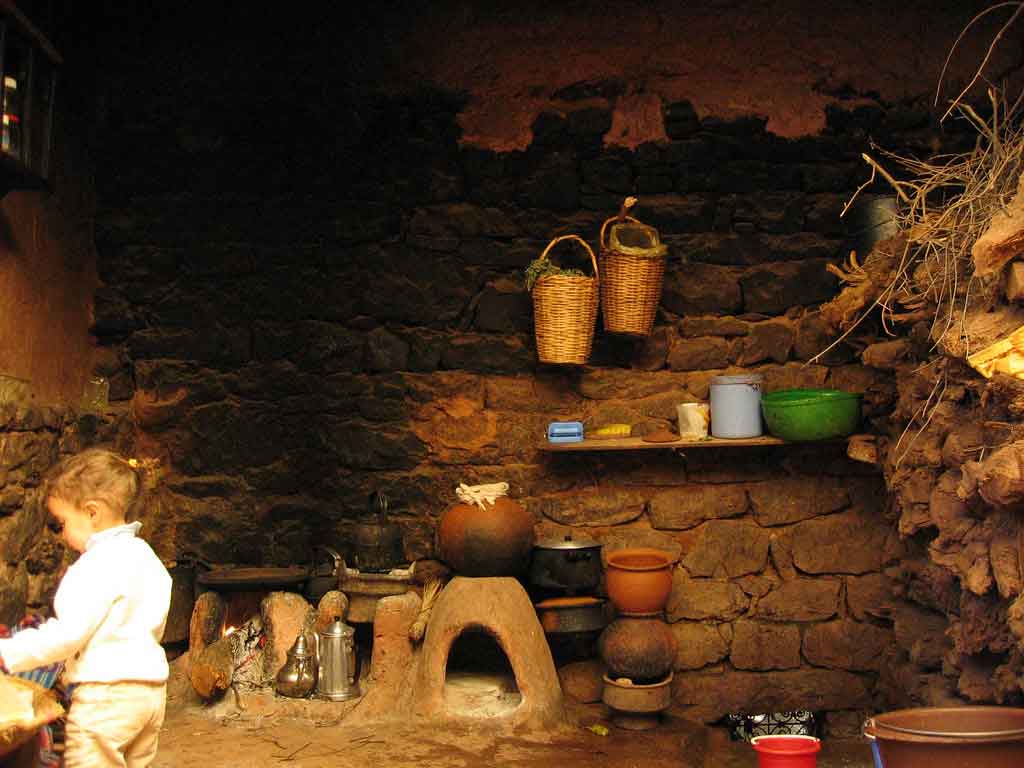
What better way to become familiar with a country than to meet local people in their homes and to stay with them and sharing meal? Berber life-styles are totally different from those of the Arab provinces in the west.
Berber life is immediately apparent crossing the High Atlas Mountains with Berber villages on the slopes, and valleys full of fields and gardens, growing olives, walnuts, fruit trees, lucerne and vegetables. These are replicated all along the way, again and again, and you can even have tea or spend the night with nomads.
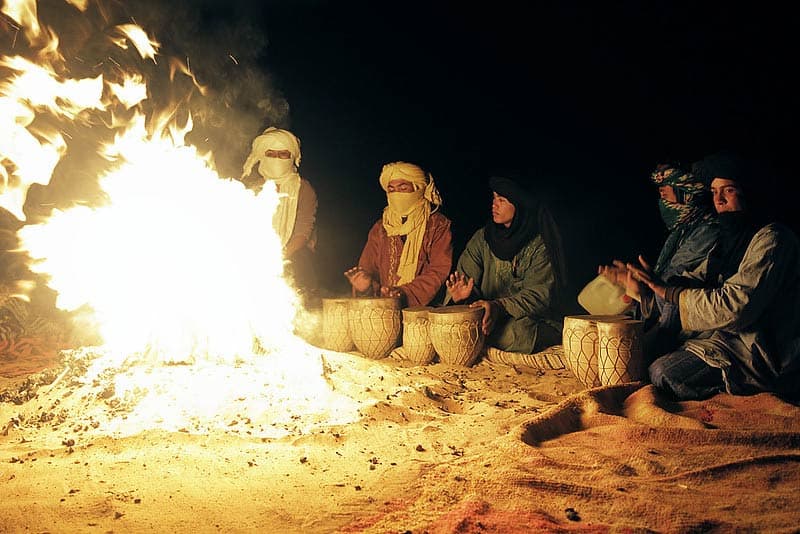
In the desert, accompany your camel man to your own private desert camp in the dunes, where he will make dinner and erect your tents for the night. You are surrounded by the calm, silence, stars and magic of the desert.
Continue on a full day’s trekking in the highest dunes of the Sahara Desert in Morocco, absorbing this unique space which will stay in your memories and hearts forever.
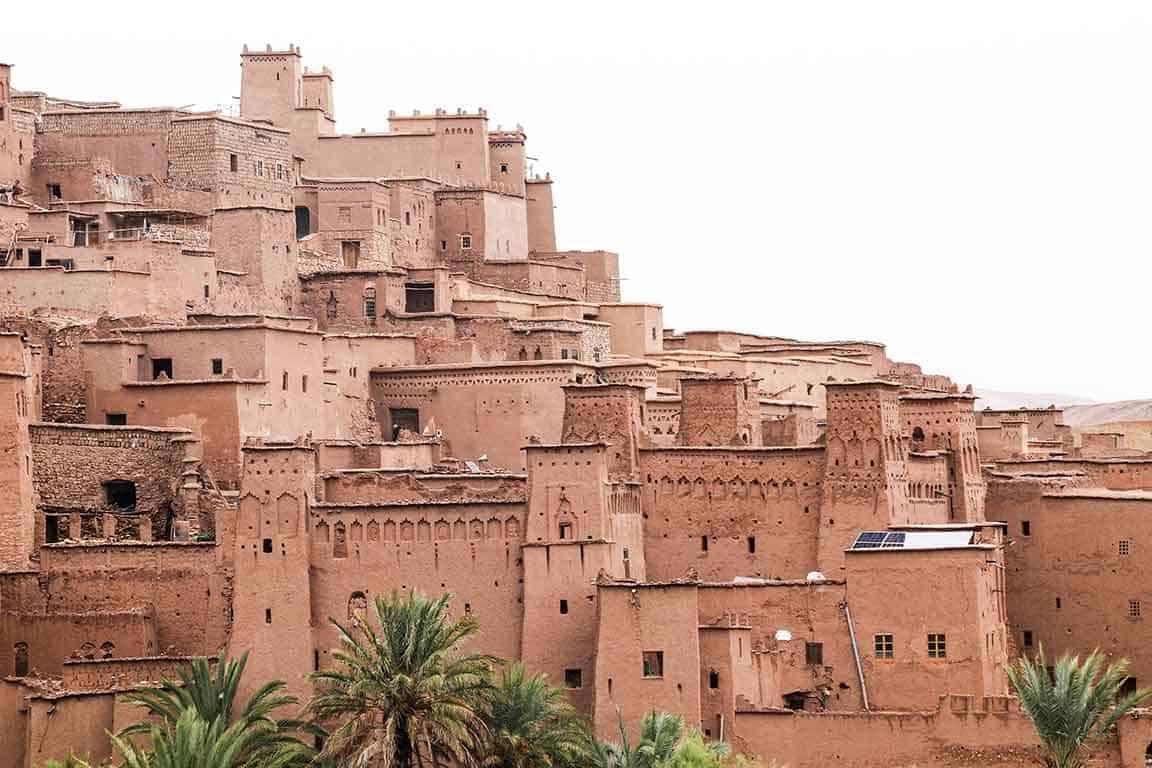
On your return to Marrakech, you come to the Dra’a Valley, where you can wander the oldest Kasbah in the valley in Tamnougalt before spending the night in a candle-lit family-run Kasbah in the most famous adobe fortified village, the Ksar of Ait Ben Haddou.
| No Days | Meals |
|---|---|
| All-inclusive | |
| Total price | |
| 2 Persons |
|---|
| 755 € * |
| 1510 € * |
| 3 Persons |
|---|
| 695 € * |
| 2085 € * |
| 4 Persons |
|---|
| 655 € * |
| 2620 € * |
| 5 Persons |
|---|
| 615 € * |
| 3075 € * |
| 6 Persons |
|---|
| 615 € * |
| 3690 € * |
It’s an 8.30 departure from your hotel/riad in Marrakech to drive across the High Atlas Mountains. At panoramic viewpoints, there will be opportunities to stop and take photos. You cross the Tizi-n-Tichka pass, the highest pass in North Africa at 2260 metres. It forms an invisible “border” between the northwest of the country and the southeast, where the landscapes, rock formations, and architecture change dramatically. Now you are in Berber country. The fields and gardens are filled with fruit trees: apple, pear, quince, pomegranate. There is also an abundance of olive, almond, and walnut trees. At different times of the year, their produce is offered at the side of the road along with wild mushrooms and thyme.
Have lunch in a Berber family-run guest house on the terrace overlooking the river valley. Spend the first homestay night in a traditional guest house run by a local Berber family in a secluded Berber oasis. You can wander through this village to gain a clear insight into Berber village life.
The road continues through the Skoura Oasis, full of crumbling Kasbahs. The most famous, Kasbah Amredhil, waits for a very worthwhile visit. The kasbah has been beautifully restored and gives a clear idea of life within such housing. It is made entirely of adobe, an excellent building material; warm in winter and cool in summer, due to the thickness of the walls.
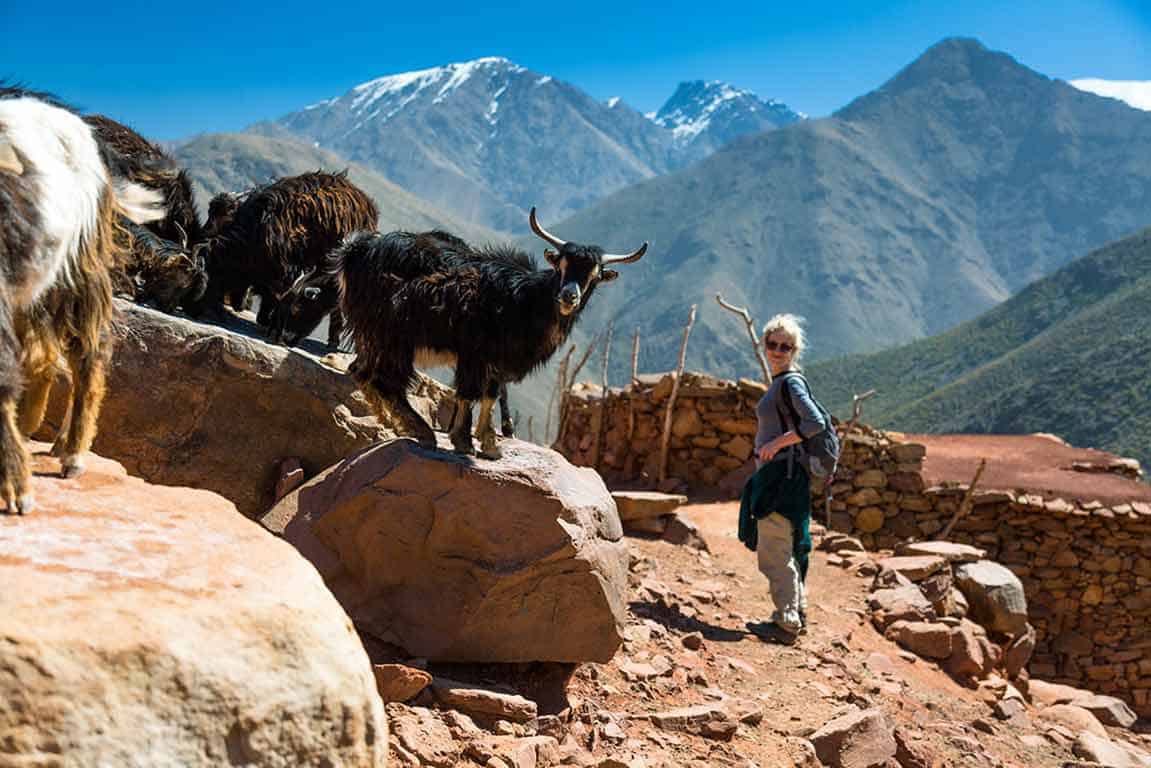
Further on, we come to Kela’a M’gouna, the Valley of Roses, with a stop to see the cosmetic products of the valley’s abundant, sweetly scented Damascene roses. An off-road route leads through the geologically fascinating landscape and local villages. Have tea in the valley with Berber nomads tending their goats and living in caves! This visit makes it clear how hard the existence is for these nomads in this very dry landscape, trying to feed their goats and bring up their children.
In the fertile Dades Valley, you spend the night with a Berber family. The more intrepid can climb for a couple of hours to other Berber nomads in their mountain caves. Or you can sleep in a traditional guest house by the Dades River.
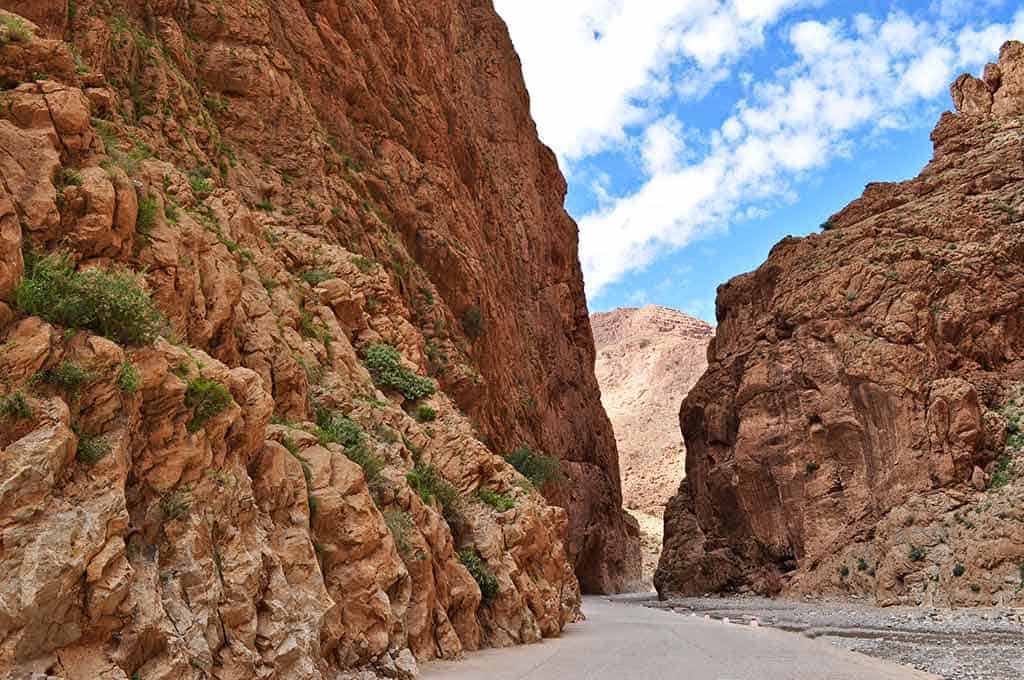
After breakfast, there is time to walk by the river before continuing to Toudgha to the very different gorges there.
After Tinjdad, you pass the water channels – “khettarat”. You can descend into them to appreciate the genius behind this form of irrigation preventing evaporation in the summer heat. This is a system used for the catchment of underground water via a system of wells all closely placed to each other in underground galleries. They make use of the slopes in the terrain, which then later emerge at the surface of the soil to irrigate the fields. You can find out more about these channels by reading Andrew Wilson’s work.
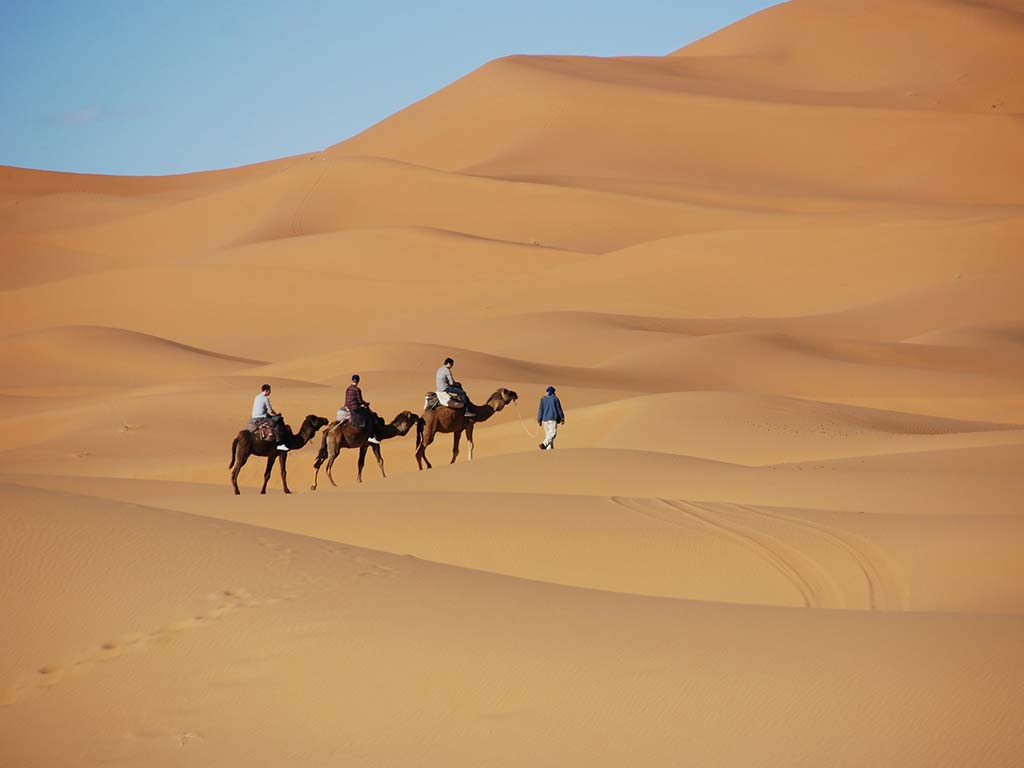
Visit Erfoud, the most famous area for its uncountable fossil finds and the workshops turning them into artifacts. At the camp in Erg Chebbi in the afternoon, you can take the camels out into the dunes with a local guide to spend the night, like the nomads, in the quiet majesty of the desert.
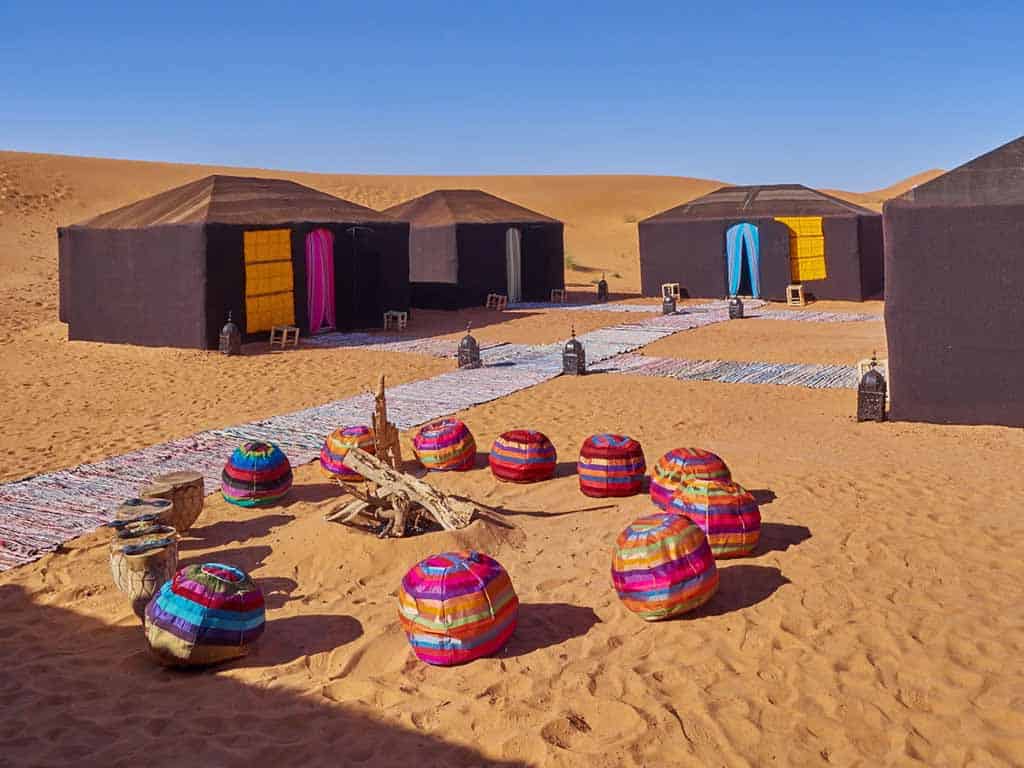
You have dinner and spend the night at an authentic nomad camp with shared bathroom facilities and a private tent for each couple or family.
Or you can choose a luxury camp with a private bathroom, king-sized beds, beautiful Moroccan furnishings, and lamps.
After breakfast, you continue with the camels, either riding or walking behind. They carry everything for your lunch, which will be prepared out in the dunes by your camel man.
You’ll walk about three hours in the morning, followed by another three in the afternoon with another night in your own nomad camp in the dunes.
Alternatively, after breakfast, you will explore the local area more fully. First of all, you will be visit the Gnawa people in the village of Khamlia. They specialize in Gnawa music brought from sub-Saharan Africa with the slave trade. They will play some for you.
Afterward, you will visit the ancient city of Rissani. This small town was the foundation of the Alaouite dynasty – the current ruling royal family in Morocco. It is surrounded by 360 ksars (a ksar is a fortified village with many towers) and has a large souk (an open market) held three times a week. Here you’ll walk through the traditional Berber souk selling spices, vegetables, household goods, and handicrafts. Rissani has been built on the site of Sijilmassa, the meeting place for the salt caravans, coming from Timbuktu in Mali.
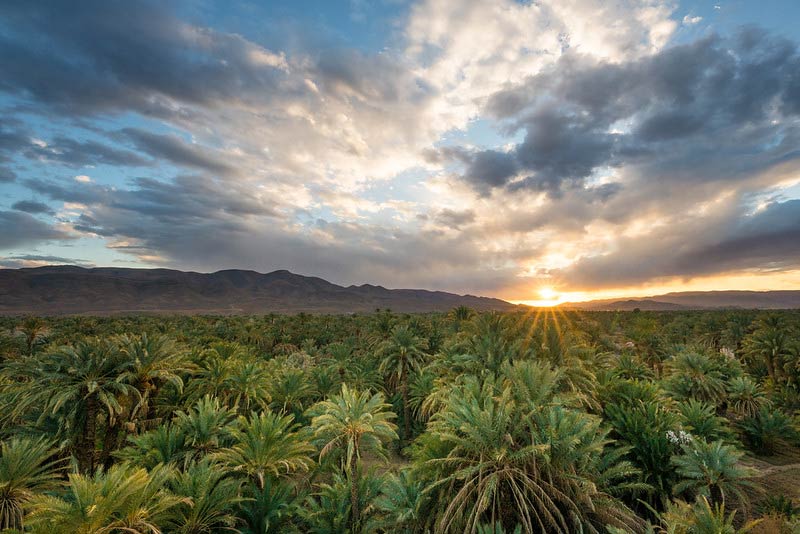
If you wake up early enough, you can watch the spectacle of the sunrise, when the colour of the dunes and the play of shadows are an awesome sight. You continue to the Dra’a Valley via the village of Tazzarine (featured in the film ‘Babel’). Lunch is in N’Qob. In the afternoon you join the Dra’a Valley with its huge date palm trees and ancient villages at Tansikht.
We pass many villages and gardens to gain a better idea of the way of life in the life-giving oases. You stop to visit Kasbah Tamnougalte, the oldest Kasbah in the Dra’a Valley. It seems time has almost stood still for some thirteen resident families. We continue over the mountain pass of Tizi-n-Tinfifte (1660m), also featured in one of the most dramatic scenes of the film, “Babel”.
About 30 km from Ouarzazate, we reach the Ksar Ait ben Haddou, to spend the night in a very traditional Kasbah. It is owned by a Berber family and no electricity has been added. Enjoy a candle-lit dinner.
After breakfast, you will have plenty of time to visit the rest of this famous Ksar. It is one of Morocco’s nine World Heritage sites, and a backdrop for many of the Hollywood blockbusters. Some of the buildings date back to the 17th century.
From here you drive along the beautiful and awe-inspiring Ounila Valley. The valley is full of surprises at the colors of the rock and soil, the Berber villages and gardens, as well as smaller Kasbahs.
We continue to Telouet set right in the midst of the mountains. This was once the seat of the last Pasha of Marrakesh, El Glaoui, who controlled much of the area. Each addition to the building now stands in ruins exposed to the wind and the rain. After the last Pasha’s property was confiscated for conspiracy against the King, the palace was plundered. Wait to be pleasantly surprised by the traditional interior decoration as you reach the farthest end of the Kasbah.
Sadly, the entire Kasbah is presently closed due to the destruction caused by the earthquake that hit Morocco in September 2023. Nonetheless, you can still enjoy the exterior with a local guide to uncover its fascinating history.
At the end of the afternoon, having crossed the Tizi-n-Tichka pass again, we arrive in Marrakech.